Plan your visit to San Nicolás Church
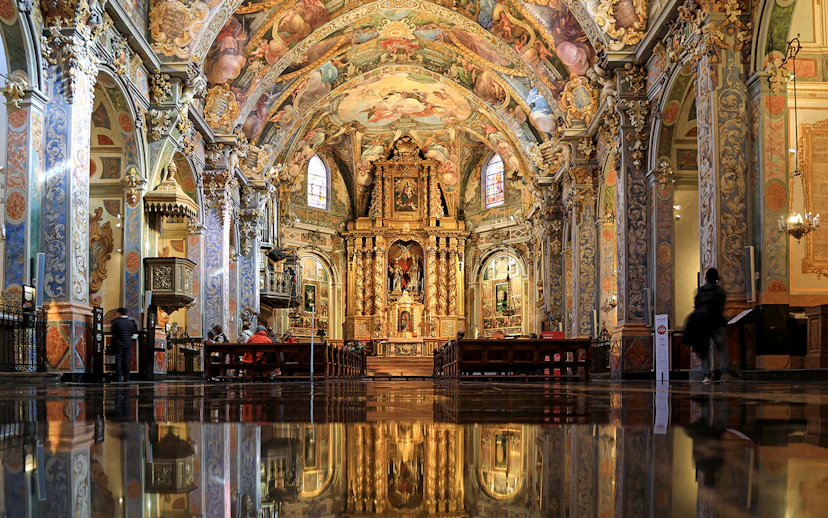
San Nicolás Church is a compact Gothic-Baroque parish church in Valencia best known for its restored ceiling frescoes and hourly immersive light projection. This is not a sprawling cathedral visit: most people spend 45–75 minutes here, and the experience depends heavily on timing the projection well and using the included audio guide. Arrive too late or miss the top-of-the-hour show, and the visit can feel shorter than expected. This guide covers hours, entry, pacing, and what to focus on once you’re inside.
Quick overview: San Nicolás Church at a glance
If you only read one section before booking, make it this one.
- When to visit: Tuesday–Friday 10:30am–7pm, Saturday 10am–7pm, and Sunday 1pm–8pm; Tuesday to Thursday in late morning feels noticeably calmer than spring weekends and March festival dates because the nave is small and visitors cluster around the hourly projection.
- Getting in: From €15 for standard entry; guided and after-hours visits run on limited departures, and booking ahead matters more for weekends, holidays, and Fallas than for a quiet midweek slot.
- How long to allow: 45–75 minutes for most visitors, stretching toward the longer end if you stay for the projection, use the audio guide properly, and slow down in the side chapels.
- What most people miss: The Communion Chapel and the Renaissance Retablo del Calvari are easy to skip because many visitors leave right after the projection ends.
- Is a guide worth it? Yes for iconography, restoration context, and special-access formats, but the included audio guide is enough for a strong first visit at standard entry level.
🎟️ Guided and after-hours slots for San Nicolás Church can sell out several days in advance during spring weekends, Easter week, and Fallas. Lock in your visit before the time you want is gone.
Jump to what you need
🕒 Where and when to go
🗺️ Getting around
⛪ What to see
♿ Facilities and accessibility
🚫 Rules and restrictions
🗒️ Practical tips
🏛️ What else to visit?
🥗 Eat, shop and stay
Where and when to go
How do you get to San Nicolás Church?
San Nicolás Church sits in Ciutat Vella on Carrer dels Cavallers, between the Cathedral quarter and the Market/Lonja side of Old Town, a short walk from Valencia’s main historic sights.
Carrer dels Cavallers, 35-B, 46001 Valencia, Spain
- Bus: Plaza de la Reina stop → 7-min walk → easiest if you’re already exploring the Cathedral quarter on foot.
- Metro: Àngel Guimerà station → 11-min walk → the simplest public-transport option if you’re coming from a wider city stay or the airport corridor.
Which entrance should you use?
San Nicolás Church uses one main entrance, and the thing visitors get wrong most often is assuming prebooked entry means a completely separate fast-track door.
- Main entrance: Located on Carrer dels Cavallers. Expect a short shared wait during quiet periods, and a longer pause before the hourly projection or on busy spring weekends.
When is San Nicolás Church open?
- Tuesday–Friday: 10:30am–7pm
- Saturday: 10am–7pm
- Sunday: 1pm–8pm
- Monday: Closed
- Last entry: 1 hour before closing
When is it busiest? Weekends, March festival dates, Easter week, and late-morning to mid-afternoon slots are busiest, especially just before the top-of-the-hour projection when visitors gather in the nave.
When should you actually go? Tuesday to Thursday between opening and 12 noon is the easiest window, because you’ll get more room to look up properly before Old Town foot traffic builds.
How do you get around San Nicolás Church?
The church is best explored on foot, and most visitors can cover the standard route in under 1 hour if they time it around the projection. The main focal point is straight ahead and overhead from the entrance, so the visit works best when you stop mid-nave first instead of walking straight to the altar.
- Main nave: Restored Baroque fresco vault over the Gothic structure → the core visual experience → allow 10–20 minutes.
- High altar area: Best place to read the ceiling’s iconographic climax and altar framing → allow 5–8 minutes.
- Communion Chapel: Later devotional side space with a different spatial feel from the nave → allow 5–10 minutes.
- Baptismal Chapel / collection area: Home to the Retablo del Calvari and smaller collection details most visitors rush past → allow 5–10 minutes.
- Interactive rooms: Short interpretive spaces tied to the immersive layer and church history → allow 10 minutes total.
The best route is simple: stop mid-nave first, catch the next projection if it’s close, then do the altar end, side chapels, and interactive rooms. Most visitors miss the smaller collection pieces because they treat the projection as the end of the visit instead of the midpoint.
Maps and navigation tools
- Map: This is not a many-room monument, so there isn’t a major map to rely on; your ticket confirmation and audio guide are usually enough for the standard route.
- Signage: Basic wayfinding is sufficient for the main visit, but it’s easy to miss the side spaces or projection timing if you haven’t read the entry instructions first.
- Audio guide / app: A multilingual audio guide is included with standard entry, and it adds real value here because the church is visually dense and easy to under-read without context.
What are the most significant spaces in San Nicolás Church?

Main nave fresco vault
Era: Late 17th-century Baroque decoration over a Gothic structure
This is the reason most people pay to enter. Nearly 2,000 square meters of frescoes cover the vaults, ribs, and columns, and the first mistake visitors make is walking too fast toward the altar instead of stopping in the middle of the nave and looking up. The thing many people rush past is how completely the painted program reshapes the Gothic shell.
Where to find it: Stand mid-nave, a few paces in from the entrance, and look straight upward before moving on.
High altar and heavenly glory scene
Artist / program: Iconographic scheme designed by Antonio Palomino and executed by Dionís Vidal
The altar end gives the ceiling its clearest narrative finish, with the arrival of Saint Nicholas and Saint Peter Martyr framed in a much more legible way than in the busier central vault. Most visitors look briefly, take a photo, and move on too fast. Slow down here and let the audio guide explain the hierarchy of the scene.
Where to find it: At the far end of the nave above and around the High Altar.
Communion Chapel
Era: Begun in 1760 and later expanded and restored in 1853
This side chapel matters because it breaks the visual rhythm of the main nave and shows that San Nicolás is more than one spectacular painted room. Visitors often leave after the projection and never step into it, which is a mistake if you want the church to feel layered rather than one-note.
Where to find it: Off the main church route, branching from the principal worship space.
Retablo del Calvari
Artist / era: Rodrigo de Osona, Renaissance
This is one of the church’s strongest art-history surprises and proof that San Nicolás is not only a ceiling attraction. Because the frescoes dominate attention, many visitors never register that a major earlier painted work survives here. If you like seeing how different periods sit together inside one religious space, this is worth the extra pause.
Where to find it: In the Baptismal Chapel, within the church’s collection route.
The immersive projection
Creator / format: Permanent light-and-sound interpretation layer opened in 2025
On paper, this can sound gimmicky, but in practice it helps isolate scenes and details that many first-time visitors would otherwise miss in the overloaded ceiling. The common mistake is assuming it runs continuously. It doesn’t — timing matters, and arriving just after it starts means either waiting or missing one of the visit’s best parts.
Where to find it: Projected in the main nave on the hour.
Facilities and accessibility
- 🎒 Cloakroom / lockers: Public visitor pages do not clearly advertise lockers or baggage storage, so treat this as a small-bag visit rather than a stop for rolling luggage.
- 🍽️ Cafe / restaurant / food stalls: No on-site café is surfaced in current visitor material, and the practical plan is to eat before or after in the surrounding Old Town streets.
- 🪑 Seating / rest areas: Seating is built into the church setting rather than arranged like a museum lounge, which is enough for a short stop but not for a long indoor break.
- 🚻 Restrooms: Public-facing pages do not clearly market restroom access as a visitor amenity, so it’s smarter to use nearby Old Town facilities before you enter.
- ♿ Mobility: Public listings surface wheelchair access on the standard route, but special after-hours or rooftop-style formats should not be assumed step-free without checking the exact ticket.
- 👁️ Visual impairments: The included audio guide helps with interpretation, but this remains a highly visual visit and public pages do not clearly surface tactile or specialist navigation tools.
- 🧠 Cognitive and sensory needs: The quietest experience is usually Tuesday to Thursday late morning, while the hourly projection adds light and sound that can feel intense in a compact space.
- 👨👩👧 Families and strollers: The standard route is short and manageable for most families, though public visitor pages do not clearly advertise baby-changing facilities or a fully stroller-optimized path.
San Nicolás Church works best for older children who can focus for 45–60 minutes and enjoy a strong visual payoff rather than hands-on play.
- 🕐 Time: 45–60 minutes is realistic with children, and the projection plus one or two key spaces is usually a better plan than trying to hold their attention for every stop on the audio guide.
- 🏠 Facilities: Family value comes more from free entry for children under the age of 12 years and the child audio guide than from dedicated family infrastructure.
- 💡 Engagement: Ask children to spot symbols or painted figures in the ceiling before the projection begins, then let the show reveal what they missed.
- 🎒 Logistics: Bring only a small bag, arrive 10–15 minutes before the hour, and skip the visit if your child is already tired because this is still an active church with quiet-behavior expectations.
- 📍 After your visit: Head toward Plaza de la Virgen or the Central Market area for a snack stop and a less structured reset.
Rules and restrictions
What you need to know before you go
- Prebooked tickets are the easiest option because on-site buying can carry a surcharge and still feeds into the same shared entry flow.
- Arrive at least 15 minutes early for timed entry, because late arrival does not entitle you to a refund and can make you miss the next projection cycle.
- Bring a small day bag rather than large luggage, because public visitor pages do not clearly advertise storage.
- Dress respectfully because San Nicolás is still an active parish church, not a museum-only space.
- Treat the visit as a single continuous stop, because public visitor terms do not clearly promise flexible re-entry.
Not allowed
- 🚫 Food and drink: This is a short heritage-church visit, so plan meals outside rather than treating the nave as a snack stop.
- 🚬 Smoking/vaping: Smoking and vaping are not appropriate inside the church and should be kept well away from the entrance.
- 🖐️ Touching artworks or barriers: Do not touch painted, carved, or devotional surfaces, because the church’s appeal depends on fragile restored decoration.
Photography
- Current public visitor pages do not surface a detailed photography policy clearly enough to promise more than the basics. If you plan to take photos, keep it discreet, avoid assuming flash or bulky equipment is allowed, and confirm with staff on arrival if you want to use anything beyond a phone camera.
- Rules can tighten during worship use or at specific moments of the immersive presentation.
Good to know
- Liturgical use can override the tourism schedule, so access may change more easily here than at a sealed museum.
- The most common planning mistake is arriving just after the hourly projection starts and then having to wait nearly a full cycle for the church’s most distinctive feature.
Practical tips
- Book 2–5 days ahead for a weekend or spring visit if you care about a specific time, but a quiet midweek slot is usually easier to secure at short notice than a guided or after-hours departure.
- Arrive 10–15 minutes before the hour and stay through the projection before doing the side spaces, because the immersive sequence is one of the few things here that can genuinely change how satisfying the visit feels.
- Don’t spend your first 5 minutes walking straight to the altar — stop in the middle of the nave, let your eyes adjust upward, and then use the audio guide once the visual shock has landed.
- Bring only what you want on your person for 1 hour, because public-facing pages do not clearly promise lockers, baggage storage, or a full museum-services setup.
- Eat before or after, not between nearby sights, because San Nicolás has no clearly surfaced internal food service and works best as a clean Old Town stop between the Cathedral quarter and the Market/Lonja side.
- If you’re visiting during Fallas, Easter week, or a holiday weekend, double-check the day’s hours and any church-use changes before you leave your hotel, because this is still a working parish and not a fixed museum timetable in every circumstance.
What else is worth visiting nearby?
Commonly paired: Valencia Cathedral
Valencia Cathedral
Distance: 450 m — 6 min walk
Why people combine them: They sit on the same Old Town circuit, and together they give you two very different church interiors — one broader and more monumental, the other denser and more visually saturated.
✨ San Nicolás Church and Valencia Cathedral are often folded into the same guided Old Town route, which is the simplest way to cover both without backtracking across Ciutat Vella.
Commonly paired: La Lonja de la Seda
La Lonja de la Seda
Distance: 650 m — 8 min walk
Why people combine them: It’s the smartest same-half-day pairing if you want one religious interior and one civic Gothic landmark without leaving the historic center.
Also nearby
Central Market of Valencia
Distance: 700 m — 9 min walk
Worth knowing: It’s the easiest post-visit stop for coffee, snacks, or edible souvenirs if San Nicolás leaves you ready for a break rather than another monument.
Centro de Arte Hortensia Herrero
Distance: 350 m — 5 min walk
Worth knowing: This is the better nearby add-on if you want to keep the art-heavy mood going instead of switching immediately to food or shopping.
Eat, shop and stay near San Nicolás Church
- On-site: There is no clearly surfaced on-site café, so San Nicolás works better as a pre-lunch or post-lunch stop than as a place to pause for food.
- Café de las Horas (4-min walk, C/ del Conde de Almodóvar, 1, 46003 Valencia): Coffee, brunch plates, and drinks in a memorable Old Town setting that fits well before or after a short church visit.
- Central Bar by Ricard Camarena (9-min walk, Mercado Central, Plaça de la Ciutat de Bruges, s/n, 46001 Valencia): Market-based tapas and sandwiches that make the most sense if you’re continuing toward Central Market and La Lonja afterward.
- Horchatería Santa Catalina (8-min walk, Plaça de Santa Caterina, 6, 46001 Valencia): A classic stop for horchata and fartons if you want something quick, local, and lighter than a sit-down lunch.
- Pro tip: Eat either before opening or after your visit, because San Nicolás is short enough that breaking your Old Town route for a meal in the middle usually wastes more time than it saves.
- Central Market of Valencia: Best for edible souvenirs like turrón, spices, olive oil, and pantry gifts, and it’s the most useful nearby stop if you’re already walking toward La Lonja.
- Plaza Redonda: Best for ceramics, textiles, fans, and easy-to-pack Valencia souvenirs in a compact historic setting a short walk from the church.
Staying in Ciutat Vella makes sense if this is part of a short first trip to Valencia and you want to walk almost everywhere. The area is atmospheric, busy, and practical for monuments, cafés, and evening wandering, but it can also be noisier and pricier than less central neighborhoods. If San Nicolás Church is only one stop on a longer Valencia trip, you don’t need to base yourself right here.
- Price point: The area skews mid-range to upscale, with the usual Old Town premium for charm and walkability.
- Best for: Visitors on a short stay who want San Nicolás, the Cathedral, La Lonja, and Central Market all within an easy walking loop.
- Consider instead: Ruzafa works better if you want more local dining and nightlife, while the Eixample side gives you an easier balance of comfort, transit, and quieter evenings without losing central access.
Frequently asked questions about visiting San Nicolás Church
Most visits take 45–75 minutes. That is enough time to see the main nave properly, use the audio guide highlights, and catch one hourly projection. If you rush in and out between projection cycles, the visit can feel much shorter and less satisfying than it should.
You don’t always need to, but prebooking is the smarter choice if you want a specific time or are visiting on a weekend, holiday, or during Fallas. San Nicolás is compact rather than enormous, so the benefit is less about avoiding a giant line and more about skipping ticket-office friction and timing your visit around the projection.
Only to a point, because prebooking helps more with timing and ticket purchase than with bypassing every on-site wait. Public supplier wording indicates that online and box-office visitors may still pass through the same shared queue. It is worth it if you care about arriving just before the next hourly show.
Arrive 15 minutes early. That gives you enough buffer to check in without stress and matters even more if you are trying to catch the next projection cycle. Arriving right on the hour is riskier here than at many attractions because missing the show changes the value of the visit.
Yes, but keep it small. Public-facing visitor pages do not clearly advertise lockers or baggage storage, so San Nicolás is best handled with a normal day bag rather than large backpacks or rolling luggage. Since the visit is short, traveling light makes the whole stop easier.
You should assume discreet personal photography is the safest baseline, but confirm the detailed policy on arrival. Current public visitor pages do not clearly spell out rules for flash, tripods, or selfie sticks, and this is still an active church, so stricter limits may apply during worship use or specific parts of the visit.
Yes, but group visits work best when arranged in advance. Standard self-guided entry is fine for small independent groups, while guided, educational, and premium formats are the better fit if you want a more structured experience. Limited-group night or special-access visits are not designed for large casual groups.
Yes, especially if your children are old enough to focus for 45–60 minutes and enjoy strong visual spectacle. Children under the age of 12 years can enter free, and there is a child audio guide. The projection helps, but this is still a church visit, not a hands-on family museum.
The standard visit is surfaced as wheelchair accessible on public listings. That applies to the normal public route rather than automatically to every premium or restricted-space format. If you are considering an after-hours or special-access tour, check that exact ticket before booking because those variants may involve different access conditions.
Food is available near the church rather than inside it. Public visitor material does not clearly surface an on-site café, but you are in the middle of Valencia’s Old Town, so cafés, horchata stops, tapas bars, and the Central Market area are all close enough to use before or after your visit.
Yes, the immersive projection is part of the core visit on standard entry. It is one of the clearest reasons San Nicolás stands out from other church interiors in Valencia. The practical catch is timing: it runs on the hour, so random arrival can mean either waiting or missing it.
There is no heavily surfaced major-basilica-style dress-code warning, but respectful clothing is still the right choice because this is an active parish church. If there is liturgical use during your visit, standards may feel stricter than at a museum. Avoid treating it like a purely casual attraction.